
What does vitamin C do in skin?
Vitamin C is an essential nutrient and a naturally occurring antioxidant in skin. Research examines its contribution to collagen biology and protection against oxidative stress. In cosmetic care, it is often selected for routines concerned with dullness, uneven tone and visible signs of ageing. Serum performance depends on the complete formula and the skin’s response to it. [1] [2]
Antioxidant care and visible radiance
Oxidative stress involves reactive molecules generated by environmental exposures, including ultraviolet radiation. Vitamin C participates in antioxidant processes and is involved in the enzymes needed for collagen formation. These biological roles explain scientific interest in the ingredient. They should be distinguished from a promise that one serum will erase wrinkles, treat pigmentation or produce a specific result within a fixed number of days. [1] [2]
Ascorbic acid and its derivatives
L-ascorbic acid is an extensively studied form of vitamin C. Derivatives such as 3-O-Ethyl Ascorbic Acid differ in chemical structure, formulation requirements and available evidence. Research on ethyl ascorbic acid investigates properties such as stability and delivery through skin. A finding for L-ascorbic acid, or for one delivery system, cannot simply be transferred to every derivative or finished product. [2] [3]
What does the concentration tell you?
A concentration on the front of a bottle is one detail. Also consider the ingredient form, supporting ingredients, packaging, instructions and how the complete formula feels on your skin. Comparing two percentages without knowing the vitamin C forms is an incomplete comparison. Choose around a clear care objective and tolerance; a higher number alone does not establish a better product. [2] [3]
Vitamin E and ferulic acid in the formula
Vitamin E and ferulic acid are frequently discussed alongside vitamin C in antioxidant research. Studies examine particular combinations, concentrations and delivery systems. This makes the full formula important: the presence of three familiar ingredient names does not prove that two serums are equivalent. Product-specific testing is needed before quoting measured antioxidant performance or clinical improvement. [2] [4]
Understanding Ellinia VITAMIN C
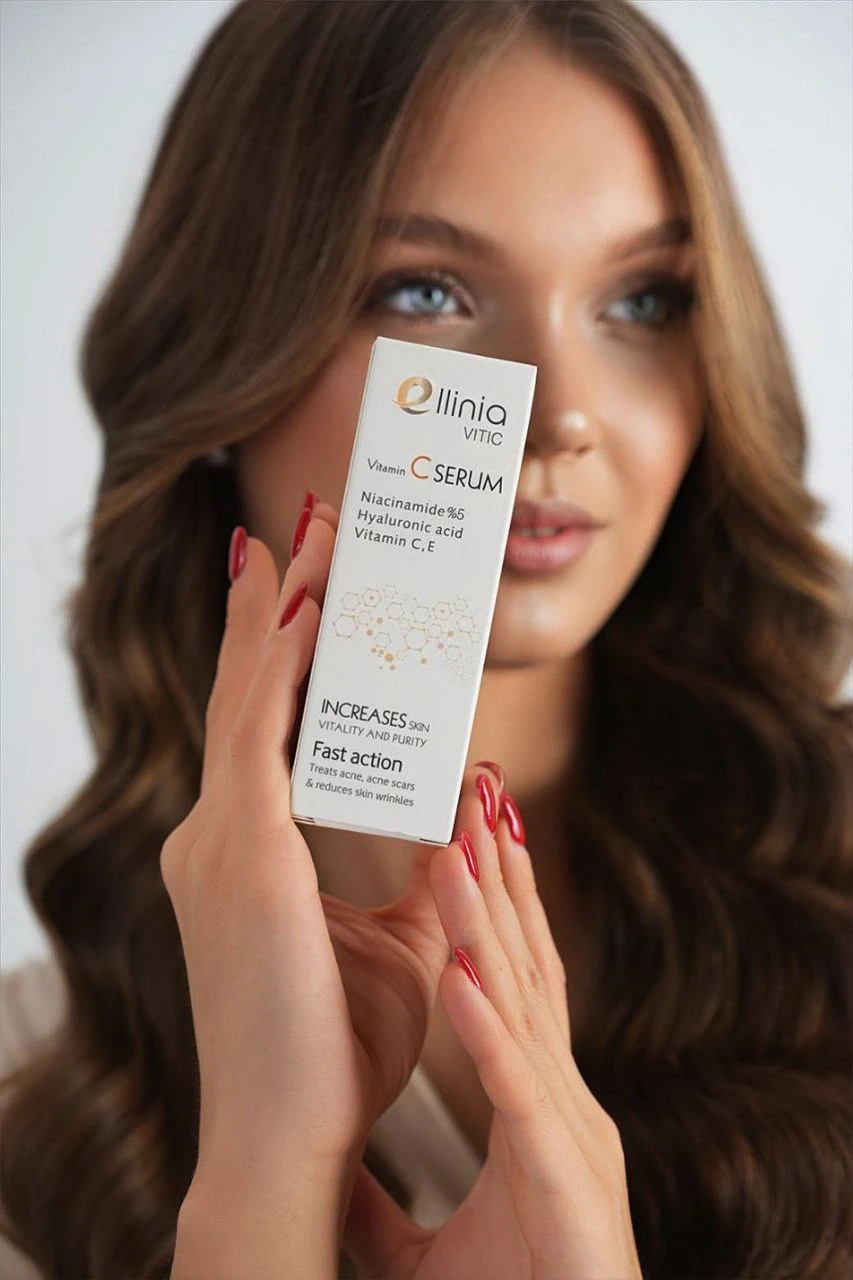
Ellinia VITAMIN C combines vitamin C, vitamin E and hyaluronic acid in a serum for radiance-focused care. It fits after cleansing and before moisturizer, following the packaging directions. The packaging is the reference for the version you use: do not infer the vitamin C derivative or its concentration from the product name. Use sunscreen during the day and introduce new products one at a time.
Adding a serum to your routine
Review the label before starting, and test a new product on a small area according to dermatology guidance. Introduce changes individually so you can identify which product your skin tolerates. Follow the serum’s own application instructions; if persistent irritation develops, stop using it and seek advice. Keep the routine manageable so you can use it consistently. [5]
Sun protection and realistic expectations
Antioxidant care complements sun protection; it does not replace sunscreen. Use a broad-spectrum sunscreen with SPF 30 or higher and follow its reapplication directions. Evaluate skincare over time under comparable conditions, rather than judging one photograph or one application. Persistent or changing pigmentation merits professional assessment instead of relying on a cosmetic serum to address every cause. [6]
Frequently asked questions
Is a higher vitamin C percentage always better?
No. The ingredient form, complete formulation and your tolerance also matter. Percentages from different derivatives are not directly equivalent.
Does vitamin C replace sunscreen?
No. Keep a separate daytime sun-protection step and follow your sunscreen’s instructions.
Can I predict a result date from the ingredients?
No. The formula, skin concerns and available product-specific testing matter; an ingredient list does not establish a fixed timeline.
Sources & further reading
- Pullar, Carr & Vissers — The Roles of Vitamin C in Skin Health (Nutrients, 2017) ↗
- Al-Niaimi & Chiang — Topical Vitamin C and the Skin (2017) ↗
- Iliopoulos et al. — 3-O-ethyl-L-ascorbic acid: characterisation and skin delivery (2019) ↗
- Ferulic Acid Use for Skin Applications — A Systematic Review (2025) ↗
- American Academy of Dermatology — How to test skin care products ↗
- American Academy of Dermatology — How to decode a sunscreen label ↗
Ingredient research describes the published evidence; it does not establish clinical results for an Ellinia product.